

Read the reflections of the organisers of the second gender lecture series
The lecture “Refusing to Conform: Trans Bodies as a Site of Resistance” explored topics of gender performance, nonbinary identity, and the history of gender resistance. The panel consisted entirely of trans and queer thinkers and activists – and rightly so: Dr. Marion Wasserbauer, Dr. Joke D’Heer, Prof. Dr. Mo Moulton, Erynn Robert and Olave Nduwanje. It inspired us to reflect more deeply on questions of resistance: how can resistance appear in everyday life through play, through awareness, or through experimenting with gender expression? How does the body itself become a space where rigid gender expectations begin to loosen? RHEA interns Sem Decraene and Maximo Meerschaut invite you into their thoughts and reflections on the panel.
Sem Decraene
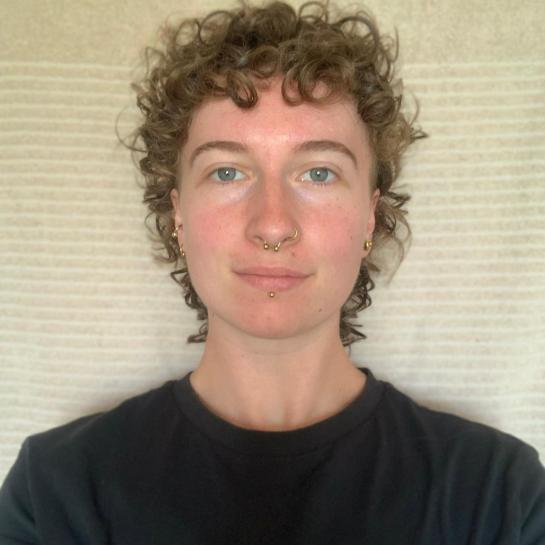
How can I try to become a body of resistance?
As the second event in our annual RHEA Gender Lecture Series, the panel “Refusing to Conform: Trans Bodies as a Site of Resistance” was a great success. The panelists explored three different aspects of trans resistance: resisting oppressive political discourse, moving beyond binary frameworks for sex and gender, and challenging/rewriting Western narratives around transness. I wondered: how can try I to become a body of resistance?
Just Have fun with it!
One piece of advice that stuck came from Olave Nduwanje, writer and podcaster, who encouraged the audience to be playful: don’t be afraid of femininity and “just have fun with it!”. This may seem simple, but it fundamentally challenges the way gender is often perceived – and policed. Gender norms rely on fear: the fear of doing the wrong thing, appearing either too feminine or too masculine, or stepping outside of what is considered acceptable. By framing gender expression as a form of play, Olave offered a way to dismantle that fear. Playing with clothing, gestures, or presentation becomes a way of refusing rigid expectations. In this sense, enjoyment itself, joy becomes a form of resistance. If gender norms depend on control, then pleasure and experimentation can disrupt that control.
Through the discussion on gender performance, femininity, and expectations that even nonbinary people can feel pressured to meet, I began to see resistance not as a dramatic act of opposition, but more as a daily practice of play, awareness, and refusal of fixed categories.
Professor of History Mo Moulton, on the other hand, situated these personal experiences within a broader historical context for me. Gender resistance has always existed. What might feel like a new or personal struggle is part of a longer history of people questioning, bending, or refusing gender norms. Shining light on this historical dimension of resistance, Prof. Moulton demonstrated how individual experimentation can be transformed into something collective. Small, everyday acts like choosing how to dress, how to move, how to present oneself, become part of a lineage of people who have resisted restrictive systems of gender way before us. In this way, the body becomes a site where the history of resistance continues to unfold.
On the paradox of resistance
At the same time, Erynn Robert, president of LGBTQIA+-association Prisme, pointed out an interesting paradox within resistance to the gender binary. Although a nonbinary identity means existing outside of binary norms, there are still stereotypes about what a nonbinary person is supposed to look like or how they are supposed to behave. Many people, consciously or not, conform to these expectations. Ironically, an identity meant to escape restrictive norms can come to produce its own recognizable aesthetic. What does it mean for resistance, I wondered, if its products become another aesthetic, another norm to conform to? Resistance lies not only in rejecting the binary, but also in resisting the pressure to embody a “correct” version of a nonbinary identity. To be a body of resistance means allowing contradiction, fluidity, and inconsistency. Being non-binary doesn’t have to mean pushing femininity away, for example: it can mean embracing it and making it your own. Refusing the idea that there is a stable or ideal way to exist outside the binary is a form of resistance in itself.
Another key message that returned throughout the panel was captured by Dr. Joke D’Heer, culture and media scientist, as follows: everybody performs gender. Everyone carries both femininity and masculinity. This highlights a central truth about gender: it is not an innate essence, but a construct enacted through everyday behavior, appearance, and social interaction. Because everyone performs gender all the time, the boundary between those who conform and those who resist becomes less clear: resistance can happen though the same everyday acts that others use to conform. Resistance may not lie in escaping performance altogether, because this is simply impossible, but in becoming conscious of how you perform and play with it.
Open-ended
So, how do I view my body as a site of resistance now? Instead of trying to find a fixed identity that perfectly defines me, I see my body as something that moves through different performances. Some days I may express more femininity, other days more masculinity, and sometimes something in between, or neither. Rather than searching for a stable position, I see these shifts as part of an ongoing exploration. This way, becoming a body of resistance is not about creating a new category but about staying open. Inspired by Olave Nduwanje’s idea of play, shaped by Prof. Mo Moulton’s historical perspective, complicated by Erynn Robert’s critique of nonbinary stereotypes, and nuanced by Dr. Joke D’Heer’s perspective, I now see resistance as a process.
Resistance means experimenting with gender expression while staying aware of the histories and norms that shape it.
Ultimately, being a body of resistance can simply mean allowing myself to exist without constantly explaining or fixing my gender for others. It means embracing play, contradiction, and pleasure in how gender is expressed. Through these small acts of experimentation, the body can become a place where rigid gender norms begin to loosen. If gender is always performed, then resistance can lie in performing it knowingly, and performing it sometimes imperfectly or playfully.
Maximo Meerschaut

What if trans bodies not only resisted cisgender and heteronormative norms, but also forced partners and care systems to change?
What happens to a society when trans bodies refuse the binary straitjacket? During this talk, it became painfully clear how deeply the gender binarity is embedded in our care systems, our legislation and our daily lives. At the same time, the speakers showed how trans and non-binary people push those boundaries every day - often putting their own bodies on the line. All kinds of bodies can be a site of resistance, but as someone with a trans body, one needs to resist binary conceptions of sex and gender in particular. To resist transphobia and Western decolonial narratives, it is necessary to do your own thing, to make your body and the narratives that surround it your own. To make your body itself say “no”. As Olave Nduwanje, writer and podcaster, said: “if you want to have fun, then have fun!”
The gender binary as a foundation and point of fracture for society
As the panelists stated so lucidly: in a world where the categories of “man” and “woman” are still treated as self‑evident, the existence of every trans or non‑binary body is automatically politicized, regardless of whether they want this or not. This tension between just wanting to exist in one’s body as a human, and constantly being reduced to a symbol, being reduced to one’s body formed the common thread of the evening. In this way, trans bodies highlight the cracks in our structures of care, safety, intimacy, housing and authenticity. Trans bodies expose the flaws and shortcomings of our cisgender‑based society. For instance, as Olave Nduwanje explained during the event, finding a place to live as a trans woman is anything but easy. Trans women are often discriminated against, marginalized, and associated with non‑autonomous sex workers. These forms of discrimination and marginalization usually remain invisible and unspoken for cisgender people.
This embodied resistance to binary norms is not a new phenomenon. Professor of History Mo Moulton illustrated this with the example of Michael Dillon, a trans man who started hormone treatment and underwent a phalloplasty already in the 1940s. The body has been a site of resistance to societal norms for much longer than we might think, and continues to be so every day for many trans and non‑binary people. Erynn Robert, coordinator of LGBTQIA+-association Prisme, described gender as a foundational force which not only organises and determines our bodies, but also shapes social hierarchies, access to resources, and forms of control. It confuses others when they cannot deduce and/or decide whether someone is “man” or “woman”. This confusion is quickly projected by society onto the person themself, who then functions as a scapegoat for broader anxieties around change.
The trans body thus becomes a kind of stress test: if the binary foundation of our gendered society turns out to be untrue, the entire structure of society is put into question.
But is this an issue in a progressive country like Belgium, one of the frontrunners on the ILGA maps (International Lesbian, Gay, Bisexual, Trans and Intersex Association Europe) and ranking highly with regard to LGBTQIA+ rights and equal marriage? Behind these statistics lies a harsh reality, however, of consistent harassment or even attacks on trans women and, in particular, trans people of colour. They also struggle to find safe housing and are more likely to work in precarious jobs or in sex work. In an institutional context this spillover between gender, class, and race is even clearer: those with fewer resources are more quickly treated as “irresponsible” and have to justify themselves more to (medical) institutions to access resources. Therefore, intersectional solidarity between trans people, people of colour, feminists, and the working class becomes a necessary form of resistance, rather than a luxury or frivolous form of identity politics, as so many believe.
The medical stage as battleground
During the panel discussion, care and medicine came up repeatedly as domains in which trans and non‑binary bodies both offer resistance and are pushed back. The gender binary remains a central and powerful concept in the medical world. Within the dominant framework, trans and non‑binary persons are expected to completely leave one box behind, in order to fit into the other. Doubt, fluidity, or refusing an unambiguous label quickly clashes with protocols, checklists and diagnoses. Gatekeepers such as doctors, psychologists and sexologists decide who is “trans enough” and who qualifies for hormone therapy and medical interventions – and who (as yet) does not. As Olave Nduwanje pointed out, class and social status have a compounding effect here, too: those with money can buy care more quickly or find workarounds, whereas those who are poor are supposedly “protected from themselves” and must undergo extensive assessment.
A clear demand was voiced: care must be both accessible and affordable. Any fears that doctors may experience about making a “mistake” should not become barriers for trans or non‑binary persons, who are then forced to wait endlessly or whose identity is rendered uncertain. At the same time as trans bodies are becoming increasingly visible in the public eye, knowledge about the lived experiences of trans and non‑binary people remain limited among (para)medical professionals.
How should we navigate this simultaneous visibility and invisibility? Can we view our bodies both as sources of knowledge and as stages on which to live life in our own ways? What would this mean for our loved ones, our surroundings and society at large?
Connection with my research
In my own research on the experiences of partners of trans persons after gender‑affirming surgery, and on trans and non‑binary couples in fertility care and early parenthood, the same mechanisms surfaced. Preliminary insights from the fertility research suggest that trans and non‑binary participants struggle with binary-oriented medical procedures, such as a transvaginal echo, and with medical documentation. However, in the research on gender-affirming surgery, the body also emerged as not only a site of medicalization and discomfort, but as a site of resistance. Intimacy within and between bodies, and the rediscovering of one’s sexuality can become part of a journey in which the cisgender heteronormative image of sexuality is punctured. The panel’s lens of “trans bodies as a site of resistance” can help us navigate this tension, and read medical guidelines and conversations differently: not as neutral descriptions, but as sites where a constant negotiation takes place over who is allowed to exist, and under which conditions, as Dr. Joke D’Heer emphasized.
What can we learn from trans and non‑binary people?
In conclusion, the norms that our society is built on are less stable than we think. Rather than seeing this as a problem, however, we should see these gaps and cracks as an opportunity to redraw the power relations surrounding them. Personal, embodied life experiences have an important role to play here, and should be taken seriously as potential sources of new forms of justice. Resistance does not only lie in big campaigns and protests, but also in choosing visibility, in seeking intimacy, and in creating joy in a world that does not always make this easy for those who dare to live outside its norms. Trans bodies show what goes wrong when systems are built on a conception of humanity that is too narrow. They also show how things can be different and hold up a mirror to us all. It is time to look at ourselves, at society and at our position within it, and to ask who we really want to be.